Your Business Doesn't Have a Software Problem. It Has a Control Problem.
Let's be real. When leads live in one platform, sales conversations happen in another, delivery runs on spreadsheets, and reporting means manually stitching numbers together on a Sunday, adding another tool does not fix that. It makes it worse.
You do not have a software problem. You have a control problem.
And here is the part nobody wants to hear: the fix is not cramming every function into one app. That usually just trades one set of limitations for another. The fix is making every critical piece run on the same logic. One source of truth for your customer data. Clean handoffs between people and automations. Real-time visibility into what is actually driving revenue.
That is the difference between a pile of tools and an operating system built for growth.
Why more software quietly becomes your growth ceiling
Most businesses buy software one panic at a time. A CRM to fix the inbox chaos. A scheduler to kill the back-and-forth. A project tool to bring order to delivery. An automation to erase a repetitive task. Every one of those decisions made sense in the moment.
The problem was never inside the tools. It is in the gaps between them.
A prospect fills out a form and never lands in your CRM. A call gets booked, but nobody scored the lead first, so your closer burns an hour on someone who was never going to buy. A deal closes and now someone is manually updating three systems to start onboarding.
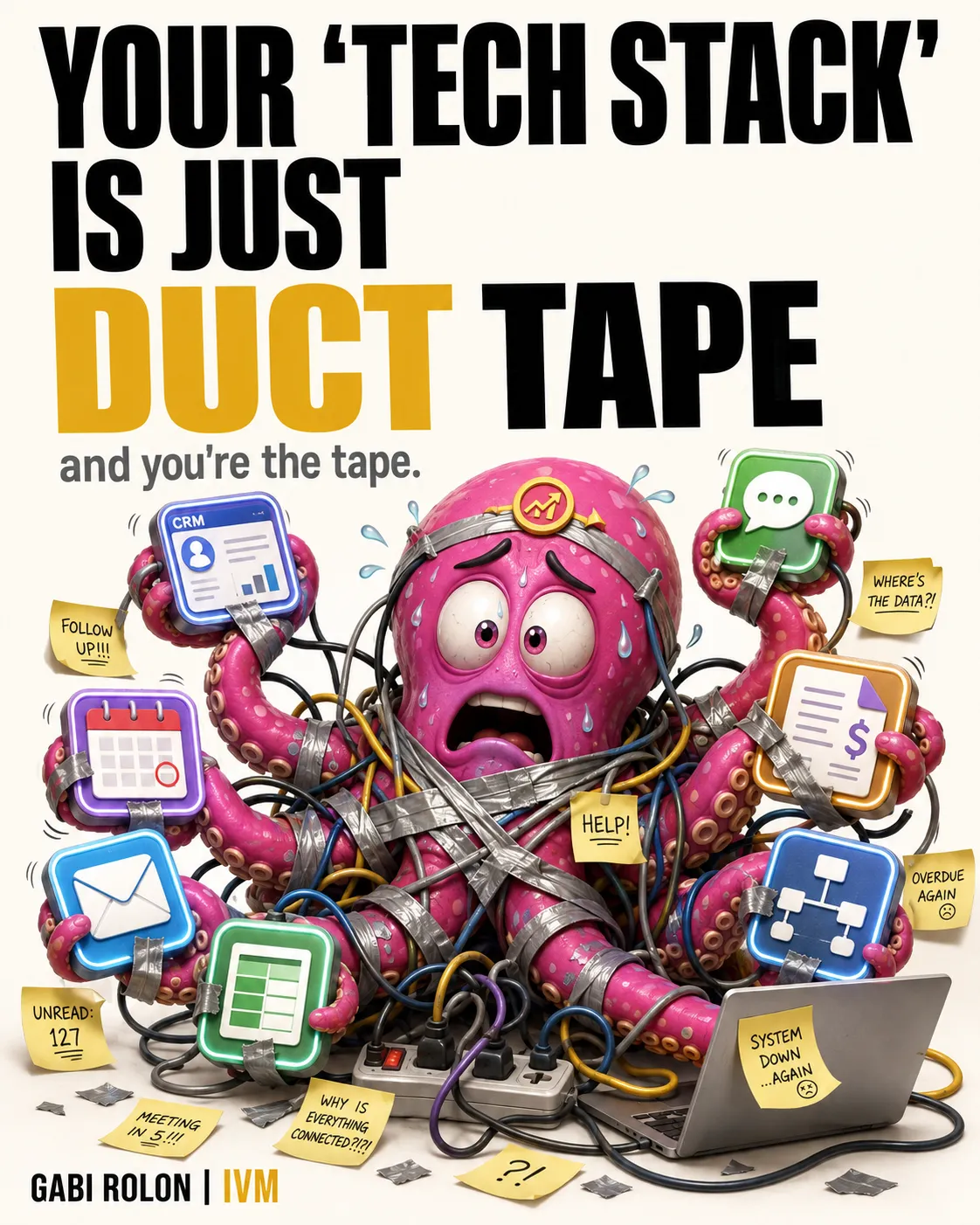
And who is holding all of that together with duct tape and memory? You. You became the integration layer. The human glue between the apps.
That survives while you are small. Then lead volume climbs, or the team grows, or the work gets more complex, and the whole thing cracks. Revenue gets impossible to predict because your data is late, scattered, and half wrong. Your team spends its day reacting to problems after they happen instead of running a system built to prevent them.
Start with the revenue journey, not the software list
Here is where most people go wrong: they start with the tools. Start with the money instead.
Your technology exists to move someone from anonymous visitor, to qualified lead, to customer, to retained account, to referral source. If a tool does not serve a real point on that journey, it is either unnecessary or sitting in the wrong place.
So map the actual movement of information through your business. For a service business that usually runs: conversion-focused website, lead capture, qualification, booking, sales follow-up, proposal, payment, onboarding, delivery, retention. At every single stage, ask three questions:
What data comes in here?
What should happen next?
Who or what owns that action?
This exercise finds the leaks fast. You will realize lead-source data vanishes the second someone books. That your sales reps cannot see the answers a prospect already gave. That onboarding kicks off with no clean record of what was actually sold. Those are not little admin gaps. Those are revenue leaks, and they are costing you real money right now.
Build one source of truth before you automate anything
A connected system needs a system of record. For most founder-led service businesses, that is your command center, the CRM or the customer database everything else connects to. It should hold what matters across the whole lifecycle: contact info, source, what they were interested in, qualification status, deal stage, communication history, purchase data, service status.
That does not mean every tool stores every field. It means you are crystal clear about where the real version of each piece of data lives. If your command center owns pipeline stage, nobody should be keeping a competing pipeline in a spreadsheet. If your payment system owns transactions, your revenue reporting pulls from verified payments, not numbers someone typed in from memory.
Get specific about ownership. Decide which platform creates a record, which one updates it, which fields automation is allowed to touch, and which changes need a human to approve. Skip this and your fancy integrations just move bad data around faster.
Audit your stack by what it actually does for revenue
Before you consolidate anything, run an honest audit. Do not judge a tool by how popular it is or how many features it has. Judge it by what it contributes to a number you can measure.
Look at your stack across the five functions that create and protect revenue:
Acquisition: website, landing pages, forms, analytics, lead tracking
Conversion: command center, qualification logic, scheduling, sales workflows, proposals
Delivery: onboarding, project management, client communication, documentation
Finance: invoicing, payments, forecasting, profitability
Intelligence: dashboards, attribution, lifecycle reporting, alerts
For each tool, write down its owner, monthly cost, the data it holds, what it connects to, the manual workarounds you have built around it, and where it breaks. Then label it: essential, duplicative, underused, or disconnected.
The answer is not always "delete it." A specialized tool can absolutely be the right call when it does one core job dramatically better than an all-in-one. But every tool you keep needs a defined role inside the bigger system. No freeloaders.
Design handoffs that do not live in your head
The highest-value connections are not the flashy ones. They are the ones that kill the moments where context gets lost and follow-up slows down.
A real lead flow does way more than dump form submissions into a CRM. It captures source and intent, enriches the record, applies your qualification criteria, routes the high-fit prospects correctly, fires the right follow-up, and pings your sales team the second a human needs to step in. If someone books a call, your closer should already see everything they need to have a relevant conversation before they even join.
Same standard after the sale. A closed-won deal should trigger onboarding, confirm payment, lock in the scope that was sold, assign internal ownership, and give the client a clear next step. Your delivery team should never have to dig through email threads to figure out what they are delivering.
The rule: automate the predictable decisions, escalate the exceptions. Do not try to automate every weird edge case, that is how you build brittle systems that break constantly and nobody can fix. Build for the 80 percent that repeats, and create visible queues for the cases that actually need a human's judgment.
Put qualification before calendar access
Most businesses think they need more leads when they actually need better lead control. A calendar stuffed with unqualified calls looks busy while it quietly drains your sales capacity and your attention.
Your system should enforce the qualification standard you already know you need. Ask the questions that reveal fit, urgency, budget range, decision authority, and real need. Then use those answers to segment, personalize the follow-up, prioritize who your closer talks to, and send the low-fit inquiries down a different path.
This is where AI earns its keep, but only inside a clear system. An AI Employee can qualify, analyze conversations, surface intent, flag objections, and answer leads in seconds instead of days. What it cannot do is fix a vague offer, undefined pipeline stages, or a database full of junk. Build the process first. Then use AI to make it faster and smarter. That order matters, and skipping it is exactly how DIY AI setups blow up.
Build one view that runs the whole business
A connected system should make your business easier to run from the top. You need a management view that ties marketing activity to sales quality, revenue, capacity, and retention. Vanity metrics do not count.
At minimum, you should be able to see where leads came from, how fast they got a response, your qualification rate, booked-call rate, show rate, close rate, sales cycle length, revenue by source, and pipeline value by stage. The exact dashboard depends on your business, but the principle holds: every important number should point to a decision.
And do not confuse visibility with control. A dashboard that tells you about a missed follow-up after the fact is useful. A system that flags the risk and triggers an owner before the deal goes cold is worth far more. The best infrastructure does both. It shows you the truth and it creates action when performance drifts out of range.
Roll it out in phases, then optimize
Trying to rip out every tool and rebuild every workflow at once is a classic, expensive mistake. It creates chaos, kills adoption, and makes it impossible to tell what broke.
Fix the revenue-critical path first: lead capture, qualification, routing, sales follow-up, and closed-won handoff. Then connect delivery and financial visibility. Then improve reporting, retention, and the secondary automations. Test each phase on real records before you roll it out everywhere.
And document the operating rules as you go. A connected stack is not a one-and-done install. Your offers evolve, your team changes, your customers shift. Someone has to own system health, watch for failures, check data quality, and improve the workflows based on what is actually happening. This needs an operator's mindset, not a set-it-and-forget-it one. You already know how that movie ends.
The only test that matters
At IVM, we build this as one connected growth engine: conversion infrastructure, AI sales systems, and orchestration designed around the way revenue actually moves through a business. The point was never more technology. It is a business that responds faster, sells with more precision, and scales without turning you into the permanent bottleneck.
So here is the real test of whether your system works. When demand goes up, does your team gain momentum, or lose control?
Build toward the first one. Every tool, every workflow, every dashboard should make the next right move easier to see and faster to make.
Which one is it for you right now? Because you already know.