
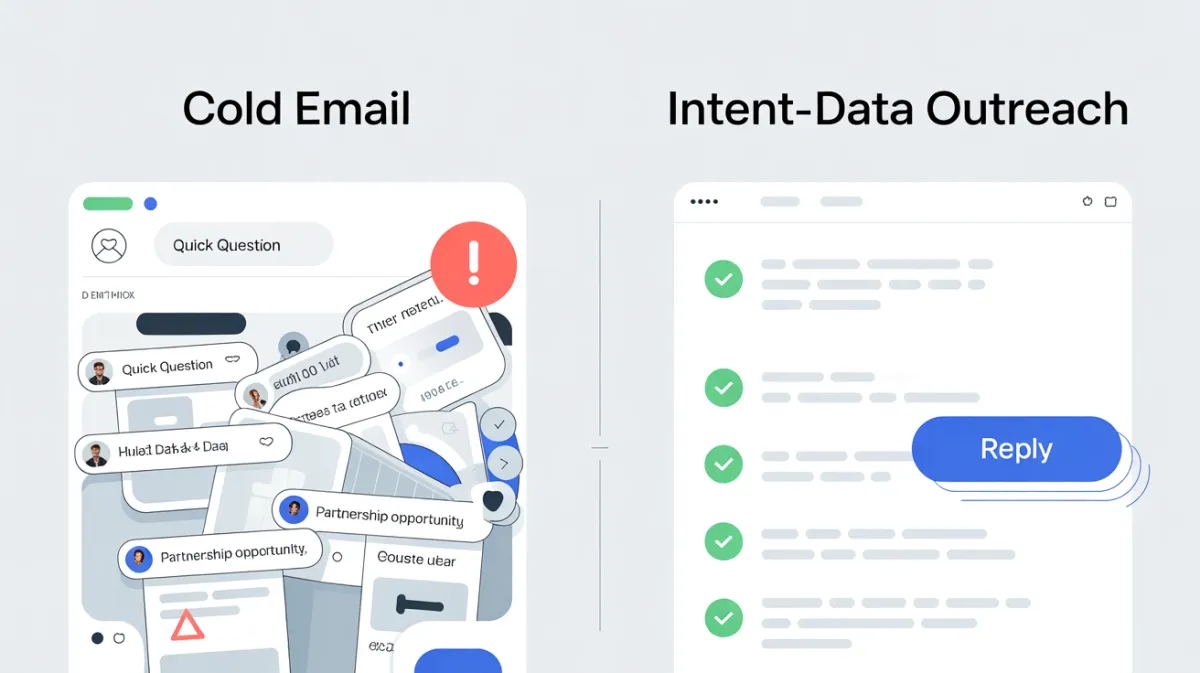
Intent-Data Outreach Explained: The New Sales Engine for High-Leverage Growth
Intent-Data Outreach Explained: The New Sales Engine for High-Leverage Growth
Cold outreach is dying.
The playbook of high-volume, generic email blasts is flooding inboxes, burning domains, and wasting time.
But here's what most founders and sales teams don’t realize, there’s a better way.
It’s called intent-data outreach, and it’s not just a tweak, it’s a total shift in how modern outbound is done.
This is the model we deploy when volume stops working.
This guide will explain:
What intent data actually is
How it works in real campaigns
Why it outperforms traditional outreach
And how to use it without sounding creepy or robotic
[See also: AI Automation for Small Businesses 2026 Guide]
What Is Intent Data?
Intent data is behavioral information that shows which prospects are actively researching or signaling interest in specific topics, products, or problems.
It tells you who’s actually in market, not just who fits your ICP.
There are two types:
First-party intent data — collected from your own website, content, or CRM. Think email opens, form fills, clicks, or user behavior.
Third-party intent data — purchased or accessed from platforms that track activity across the web. Think Bombora, ZoomInfo, Clearbit.
Used correctly, intent data doesn’t just build a list, it builds a timing advantage.
Learn more about Intent Data
Why Cold Email Isn’t Enough Anymore
Cold outreach relies on guesswork. You build a list based on titles, firmographics, or niche, then blast a generic message.
It used to work. Now it barely lands.
Why? Because everyone is doing it.
Your message gets buried.
Your domain gets flagged.
Your brand loses credibility.
The modern inbox is ruthless.
Intent-based outreach solves this by:
Prioritizing contacts with actual buying signals
Enabling hyper-relevant messaging
Lowering send volume while increasing reply rates
You go from interrupting strangers to engaging buyers.
[Related: Cold Email vs Intent-Data Outreach — What Works in 2026?]
How Intent-Based Outreach Actually Works
Here’s the shift:
Old model:
Buy a list
Send 500 emails
Get 5 replies
New model:
Use intent data to find accounts researching your category
Layer on job titles, engagement history, and signal strength
Send 50 personalized emails
Get 10 qualified replies
It’s not about more volume, it’s about more signal.
This is what we see outperform in real campaigns.
Platforms like Clay, 6sense, Apollo, and PhantomBuster now make this not just possible, but repeatable.
[Explore: How AI Personalizes Outreach at Scale]
Why It Works Better Than Lead Lists
Lead lists tell you who could be a fit.
Intent data shows you who’s actively looking.
It’s the difference between fishing in a random lake and casting into a stocked pond.
With intent-based targeting, your emails:
Arrive with relevance
Open with context
Convert because of timing
It’s not magic. It’s signal-driven prioritization.
And when paired with AI and smart workflows, it becomes a repeatable system, not a one-off campaign.
[See also: The Intelligent Agent Framework — Automate Outreach Without Losing Personalization]
Where Most Outreach Fails
Even with good data, most outreach flops because of:
Bad timing — hitting people before they care
Weak copy — generic, self-centered, uninspired
No follow-up — one-and-done messages with zero persistence
No system — random actions, not measurable pipelines
Intent data fixes timing.
AI fixes copy.
Agents fix follow-up.
Systems fix scale.
You need all four.
What a Modern Outreach Stack Looks Like
Signal Source — intent providers, analytics, CRM triggers
Replaces guessworkData Layer — enrich profiles, verify emails, tag signals
Replaces bad lists and bouncesPersonalization Engine — AI writing tools, brand voice templates, dynamic references
Replaces generic cold copySend Engine — smart senders like Instantly, Smartlead, or manual with safeguards
Replaces domain burnAgent Layer — follow-up automation, reply classification, meeting routing
Replaces SDR churnFeedback Loop — monitor open/reply rates, optimize based on signal quality
Replaces static outreach
Outreach Examples That Work
Example 1: SaaS company sees a spike in product category searches.
Agent identifies 50 target accounts showing signal. Outreach references recent webinar topic and links to relevant use case. 12 meetings booked in 7 days.
Example 2: Consultant notices traffic to pricing page from a mid-market company.
Agent sends 3-email sequence referencing industry case study. Call booked after second follow-up.
Example 3: Services firm gets Slack intent trigger via Clearbit.
AI writes hyper-personalized message referencing company growth. CTA asks about ops scaling. Positive reply same day.
[Explore: Why Follow-Up Matters More Than Volume — The Secret to 70%+ Reply Rates]
How to Build This Into Your Business
Choose 1 intent source (start simple: website visits, pricing page views)
Set up triggers or alerts when signals match your ICP
Create 3–5 email variations that reflect the buyer’s stage or behavior
Use AI to personalize each message (not just name and company)
Build an agent to follow up automatically with logic (if no reply, send X)
Track replies, meetings booked, and refine based on data
This becomes your new outbound system.
Final Word: Outreach Isn’t Dead. Cold Outreach Is.
Buyers are still reading emails.
They’re just ignoring ones that sound like everyone else.
If your team is working harder for worse results, or you’re still blasting cold lists hoping something sticks, it’s time to shift.
Build your engine around intent, not interruption.
Intent-data outreach is how you:
Send less
Say more
Get better results
[Start with an intent-data audit and identify signals your current system is missing.]