Intelligent Agents VS Tools What Smart Business Owners Need To Know
Intelligent Agents vs Tools: What Smart Business Owners Need to Know
Not all AI is created equal.
If you're using ChatGPT to write emails or Zapier to connect tools, you're not doing anything wrong — but you're not operating at full leverage either.
Most businesses are stacking tools on tools. What they really need is an agent.
This guide will show you the difference, why it matters, and how to shift from assisted work to autonomous execution.
[See also: AI Automation for Small Businesses 2026 Guide]
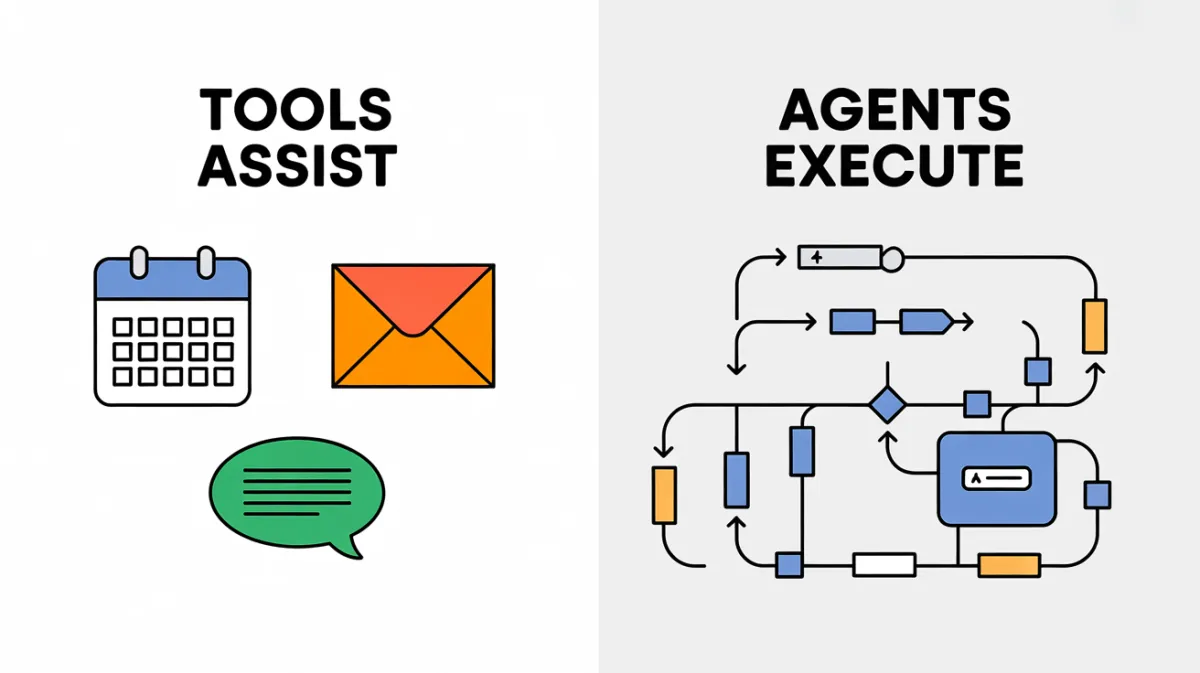
Tools Help You Work Faster, Agents Help You Stop Working
Tools are extensions. They enhance your effort.
An email tool helps you send faster. A scheduling tool helps you book cleaner. A chatbot tool helps you triage.
But they still depend on you to drive the process.
Agents are different.
An intelligent agent owns the outcome. It doesn’t just assist — it executes.
It:
Triggers automatically
Follows logic and feedback
Runs end-to-end workflows
Learns from results and adapts
A tool is a better shovel. An agent is a self-driving excavator.
[Related: The Intelligent Agent Framework — How to Automate Real Work]
Key Differences: Tools vs Intelligent Agents

Why Tools Plateau, and Agents Scale
Tools make your current process faster. But if your process is still manual, broken, or unoptimized — all you’ve done is speed up inefficiency.
Agents don’t just run tasks. They own the entire loop — input, logic, output, feedback. That’s where scale lives.
Example:
A tool sends a follow-up email.
An agent follows up, handles objections, updates the CRM, and books the call.
Multiply that by 100 leads per month, and you see the difference.
When to Use Tools
Tools are useful when:
You’re doing something manually and want a faster way
You’re testing a new workflow or content strategy
The task requires your judgment but needs assistance
Use tools for:
Drafting content
Scheduling calls
Simple automations with clear triggers
Support responses that need editing
When to Use Intelligent Agents
Agents are ideal when:
The process is repeatable and outcome-based
Speed and consistency are critical
You want leverage without more hires
You’re overwhelmed managing tools and VAs
Use agents for:
Sales follow-up and call booking
Inbound lead routing and qualification
Client onboarding and task tracking
Content repurposing and distribution
Inbox triage and tagging
[Explore: AI vs VA — The Only Comparison Small Business Owners Need]
What Agents Actually Look Like
An intelligent agent is not a chatbot.
It’s not a one-time automation.
It’s not another SaaS tool with an AI label.
It’s a coordinated system — usually built with no-code tools — that connects:
Input triggers (like a new lead)
Business logic (if qualified, do X)
Content modules (email, message, post)
Output actions (send, update, tag)
Feedback loops (booked, replied, ignored)
And runs the whole thing with minimal oversight.
[See the full breakdown: The Intelligent Agent Framework]
Real Business Examples
Example 1: Sales Agent
Trigger: New lead comes in from website
Actions: Sends personalized follow-up, handles objections, qualifies, books a call
Feedback: Improves based on booking rate and replies
Example 2: Marketing Agent
Trigger: New podcast episode goes live
Actions: Summarizes content, creates posts, writes emails, schedules everything
Feedback: Adjusts based on open and engagement rates
Example 3: Ops Agent
Trigger: New client payment received
Actions: Sends onboarding steps, tracks progress, flags incomplete items
Feedback: Identifies drop-off points and delays
How to Start Moving from Tools to Agents
Identify one outcome-based workflow (e.g. lead conversion, onboarding)
List the current steps and tools used
Map where things break or require manual input
Define success (e.g. booked call, completed form)
Build a simple version using no-code tools or agent platforms
Run it for 10 use cases and track results
Final Word: Stop Managing Tools, Start Deploying Agents
If you're juggling 10 apps and still doing manual follow-up — you're not automating.
Tools assist. Agents execute.
The next stage of small business scale is agent-powered, not tool-driven.
Want to see what that looks like inside your business?
[Start with an intelligent agent audit and map your next move.]